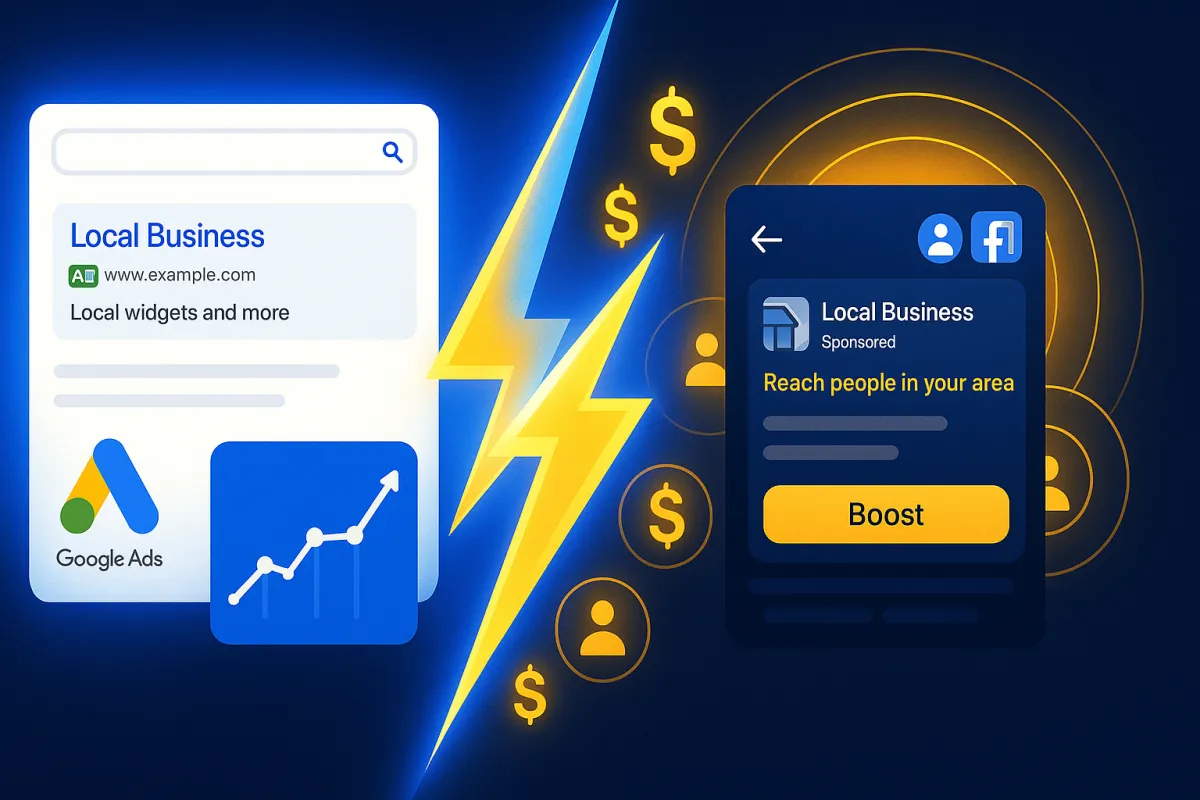
Google Ads vs. Facebook Ads: The Complete Local Business Paid Advertising Playbook for 2026
Every local business owner eventually faces the same question: Google Ads or Facebook Ads? Where should the advertising budget go to get the fastest, most reliable return? The answer -- backed by 2026 data from thousands of small business ad accounts -- is both, deployed strategically in a coordinated full-funnel system where each platform does what it does best.
At Future Level Marketing, we manage paid advertising campaigns for local service businesses across multiple industries, and the pattern is consistent: businesses that run Google and Facebook Ads together consistently outperform those that choose just one platform. But how you allocate budget between them makes all the difference.
This complete playbook breaks down everything local businesses need to know about Google Ads vs. Facebook Ads in 2026 -- the core differences, the real cost benchmarks, the best campaign types for local lead generation, and the exact budget strategy that maximizes ROI at every stage of the customer journey.
The Fundamental Difference: Intent vs. Discovery

Understanding the core difference between these two platforms is the foundation of any effective local business advertising strategy. Get this wrong and you will waste budget regardless of how well your campaigns are structured.
Google Ads captures demand that already exists. When someone types emergency HVAC repair near me or best roofing contractor in Sacramento, they have already decided they need help. They are in problem-solving mode. Google Ads places your business directly in front of that high-intent searcher at the exact moment they are ready to act. Over 30% of users click the first paid result they see, and 70% of mobile searchers call a business directly from a Google Ad -- making it the single most powerful channel for immediate, bottom-of-funnel lead generation.
Facebook Ads create demand that does not yet exist. Facebook users are not searching for your services -- they are scrolling their feed, watching videos, and catching up with friends. Facebook Ads interrupt that experience with a precisely targeted message, introducing your brand to local homeowners and business owners who may not yet know they need your services. The power is in building awareness, staying top-of-mind, and retargeting warm prospects until they are ready to convert.
The most effective local advertising strategy in 2026 uses both: Google to capture buyers who are searching right now, and Facebook to build the pipeline of future buyers who are not searching yet but will be. The strongest approach starts by capturing high-intent traffic with Google Ads and then retargeting those users on Facebook to stay top of mind and drive conversions.
Google Ads for Local Businesses: Your Bottom-Funnel Workhorse

For most local service businesses -- HVAC, plumbing, roofing, dental, legal -- Google Ads should carry approximately 80% of the paid advertising budget. Local service searches are overwhelmingly high-intent. When someone searches emergency plumber or roof leak repair, they need help now. The average CPC is higher on Google ($2.69 vs $0.62 on Facebook), but the average business earns approximately $2 in revenue for every $1 spent on Google Ads -- and in high-ticket local service industries, that ratio is often far better.
Google Ads conversion rates for local service businesses range from 5% to 10% on Search campaigns -- among the highest of any industry -- because the targeting is built around purchase intent. Over 60% of all paid ad clicks online come from Google Ads, and the platform reaches over 90% of internet users worldwide.
The 3 Google Ad Types Every Local Business Should Run
1. Google Search Campaigns -- The foundation of any local Google Ads strategy. Target high-intent keywords like [service] near me, best [service] in [city], and emergency [service]. Use exact match and phrase match keywords to ensure ads only show to searchers with genuine purchase intent. Pair every ad with a fast, mobile-optimized landing page -- a well-optimized landing page alone can improve conversion rates by 20-50%.
2. Google Local Services Ads (LSAs) -- The most powerful ad format available to local service businesses in 2026. LSAs appear above standard Google Ads, above organic results, and above Google Maps -- the absolute top of the search results page. Unlike traditional search ads where you pay per click, LSAs operate on a pay-per-lead model, charging $5-$150 per qualified lead only when a potential customer contacts you directly. The Google Guaranteed badge dramatically increases consumer trust and conversion rates. A small HVAC company with a $500/month LSA budget can realistically generate 10-20 qualified leads per month. LSA ranking is based on review score and volume, responsiveness to leads, proximity, and business hours -- meaning a business with great reviews and fast response times can outrank a competitor spending triple the budget.
3. Performance Max Campaigns -- Google AI-powered campaigns that automatically run ads across Search, Display, YouTube, Gmail, and Maps using a single unified campaign. In 2026, Performance Max uses generative AI to automatically create ad headlines and descriptions from your business inputs. Advertisers using AI-based optimization report 25% more conversions at 20% better CPA efficiency.
Facebook Ads for Local Businesses: Your Top-Funnel and Retargeting Engine

While Google captures buyers searching today, Facebook Ads for local businesses build the pipeline of buyers who will search tomorrow. Here is the key insight: users who see your Facebook ad first and then search for your services on Google convert 2-3 times better than cold Google searchers with no prior brand exposure. Facebook warms up your local market, builds brand recognition, and creates a pre-qualified audience that your Google Search campaigns then capture at peak intent.
With 20% of your paid budget dedicated to Facebook, you can run a highly effective brand-building and lead nurture operation that makes every Google Ad dollar work harder.
The 4 Facebook Ad Types That Work Best for Local Service Businesses
1. Facebook Lead Generation Ads (Instant Forms) -- The highest-converting Facebook ad format for collecting contact information. Lead Form Ads are 20-30% cheaper per lead than sending traffic to an external landing page because the form pre-fills with the user data, eliminating friction entirely. The cross-industry average cost per lead on Facebook in 2026 runs $28-$42, with local service businesses often landing at the lower end with well-targeted campaigns.
2. Video Awareness Ads -- Short-form video (15-60 seconds) is the dominant Facebook and Instagram ad format in 2026. A 30-second video showing your team at work, a before-and-after project, or a quick customer testimonial builds local brand recognition that text ads simply cannot match. Video ads cost as little as $0.01-$0.15 per view -- making it an extremely cost-efficient way to get your brand in front of thousands of local homeowners for a few hundred dollars per month.
3. Retargeting Campaigns -- Retargeting website visitors and video viewers is one of the highest-ROI tactics in local advertising. Remarketing campaigns increase conversion rates by up to 150% compared to cold traffic. For local service businesses, even small audiences of 500-2,000 website visitors can produce exceptional returns from a $300-$500/month retargeting budget.
4. Lookalike Audience Campaigns -- Upload your customer list to Meta Ads Manager and build a Lookalike Audience of local users who share the same demographic and behavioral characteristics as your best existing customers. This is how you scale Facebook Ads beyond your warm audience without sacrificing lead quality.
The 2026 Local Business Paid Advertising Budget Framework
Based on real performance data, here is the budget allocation framework we recommend at Future Level Marketing for local service business paid advertising:
- $1,000-$2,000/month total budget: 80% Google Search campaigns targeting your highest-value service keywords, 20% Facebook retargeting. Start with Google and add Facebook once campaigns are generating consistent leads.
- $2,000-$5,000/month: 60% Google Search plus LSAs, 20% Performance Max, 20% Facebook split between Lead Gen Ads and Retargeting. At this level, LSAs become highly cost-effective.
- $5,000+/month: Full-funnel deployment -- Google Search, LSAs, and Performance Max dominating local search results, with Facebook running simultaneous awareness, lead gen, and retargeting campaigns. This is where the compounding effect of both platforms truly produces extraordinary results.
For new campaigns just getting started, Google Search ads typically deliver faster results because you reach people already looking for what you sell. Facebook requires more budget and time for the algorithm to learn and optimize. Start with Google, prove the ROI, then layer in Facebook for full-funnel coverage.
Critical 2026 Tracking Requirements
One of the most costly mistakes local businesses make with paid digital advertising is failing to track conversions accurately. In 2026, third-party cookies are effectively gone. Both platforms now require specific technical setup to maintain data quality:
- Google Ads: Implement Enhanced Conversions and connect your CRM to import offline conversions (phone calls, booked appointments). Enhanced Conversions recovers up to 15% of conversions that standard tracking misses.
- Facebook Ads: The Conversions API (CAPI) is now mandatory for accurate tracking. Advertisers without CAPI lose 20-40% of their conversion data, making optimization nearly impossible.
- Both platforms: Connect your ad accounts to a unified CRM dashboard to track the full customer journey from first ad click to closed job. True ROI for local service businesses is measured in booked revenue, not just lead form submissions.
Putting It All Together: The Future Level Marketing Approach
The businesses winning at local business paid advertising in 2026 are not choosing between Google and Facebook -- they are using both in a coordinated system designed around the customer journey. Google LSAs and Search campaigns capture buyers who need help right now. Performance Max extends coverage across every Google surface. Facebook Ads build brand awareness, generate top-of-funnel leads, and retarget warm prospects until they are ready to call.
At Future Level Marketing, we build, manage, and optimize complete paid advertising systems for local service businesses -- combining strategic Google Ads campaign structure, Facebook creative development, audience targeting, conversion tracking implementation, and ongoing weekly optimization into a single managed program. We track every dollar back to booked revenue so you always know exactly what your advertising is producing.
Whether you are spending $1,000 per month or $10,000, the same principles apply: capture high-intent searchers with Google, build your local brand with Facebook, track every dollar to closed revenue, and optimize relentlessly. Ready to launch or improve your local business paid advertising strategy? Contact Future Level Marketing today for a free campaign audit and a custom roadmap to more leads, lower cost per lead, and higher ROI in 2026.