How to Run High-Converting Facebook Lead Gen Ads for Local Service Businesses in 2026
Most local service business owners who try Facebook ads for the first time make the same costly mistake: they boost a post, target everyone within 30 miles, and wait for the phone to ring. When nothing happens, they conclude that Facebook ads do not work for their business. The reality is that Facebook advertising is one of the most powerful lead generation tools available to local service businesses -- but only when it is set up correctly.
With over 3.05 billion monthly active users and targeting capabilities that allow you to reach homeowners within a precise service radius, Facebook Lead Gen Ads can generate a consistent pipeline of qualified local prospects. The average cost per lead on Facebook runs $28-$42 across industries -- and for local service businesses with the right system, costs can run significantly lower.
This step-by-step guide breaks down exactly how Future Level Marketing builds high-converting Facebook Lead Gen Ad campaigns for local service businesses in 2026 -- from campaign setup and audience targeting through lead form optimization and the follow-up system that turns submissions into booked jobs.
Why Facebook Lead Gen Ads Work for Local Service Businesses

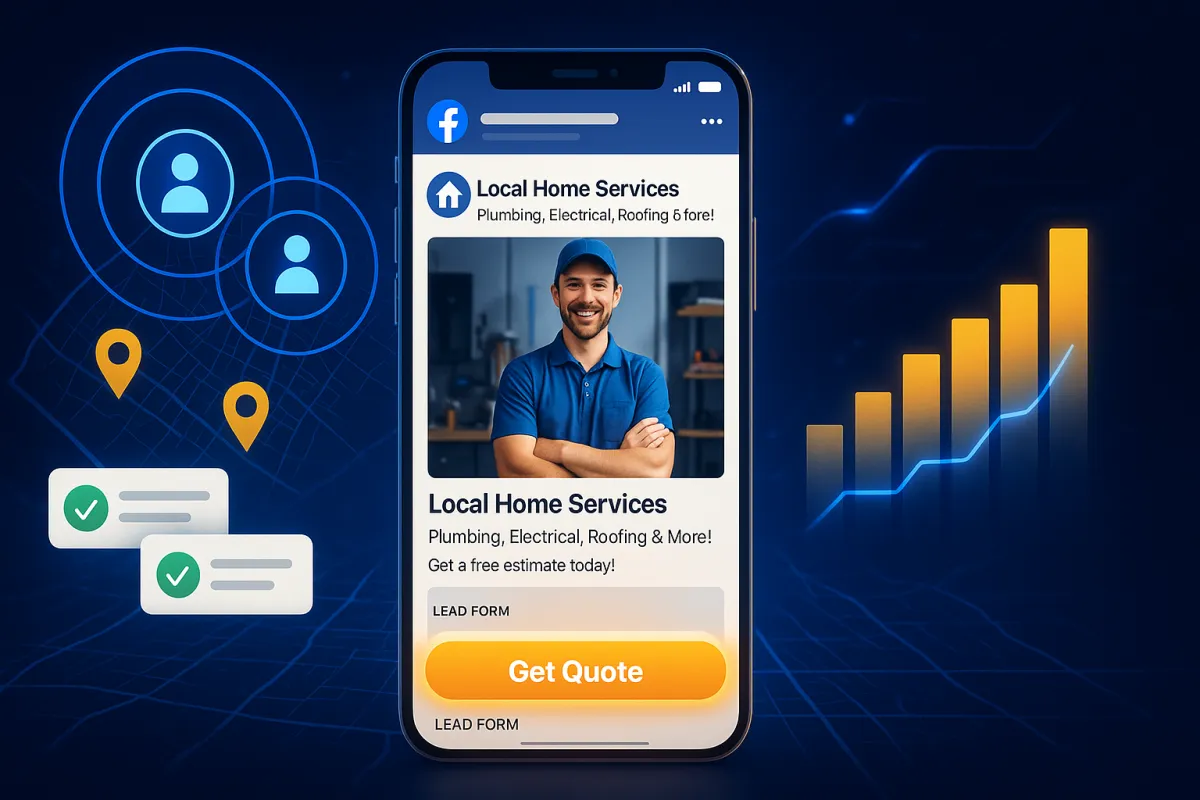
Facebook Lead Generation Ads allow users to submit their contact information directly inside Facebook or Instagram -- without leaving the app. The form pre-fills with existing Facebook data, making submission as simple as tapping a button.
This matters enormously for local service businesses. 98.5% of Facebook users access the platform via mobile devices. A traditional ad that sends people to an external landing page loses a significant portion of potential leads at every friction point. Lead Form Ads eliminate that friction, producing 20-30% lower cost per lead than campaigns driving traffic to a landing page.
For services like HVAC, plumbing, roofing, pest control, landscaping, cleaning, and dental -- anything where customers are open to being found -- Facebook Lead Gen Ads are the ideal top-of-funnel demand-generation tool.
Step 1: Campaign Setup and the Right Performance Goal
In Meta Ads Manager, select Leads as your campaign objective. At the ad set level, choose your performance goal:
- Maximize number of leads: Optimizes for volume. More form submissions, often at lower quality. Best for testing new audiences and validating your offer.
- Maximize number of conversion leads: Optimizes for quality. Shows your ad to people most likely to become actual customers. Requires connecting your CRM via the Conversions API so Meta can learn which leads convert downstream.
Start with Maximize number of leads to build data quickly. Once you have 50+ conversions per week, switch to Conversion Leads optimization -- this is where lead quality improves dramatically. Start with a minimum of $10-20 per day for the first 5-7 days to give the algorithm enough data to exit its learning phase.
Step 2: Master Your Three Audience Layers

Layer 1: Cold Prospecting
Set a geo-radius of 10-15 miles from your business address. Critical setting: change the location option from the default to People living in this location only -- the default includes travelers and visitors who will never become customers. Target an audience size of 500,000 to 2,000,000 people -- the sweet spot that gives Meta room to optimize while keeping targeting relevant. Layer in homeowner status, relevant interests, and income demographic filters.
Layer 2: Warm Retargeting
Retargeting audiences -- website visitors, video viewers, page engagers, and lead form openers -- consistently produce 35% lower cost per lead than cold prospecting. Allocate 20-30% of your budget to retargeting. A powerful strategy: run cheap 15-second video ads to build a warm audience, then retarget those video viewers with Lead Form Ads. This video-to-lead approach consistently produces the lowest overall cost per customer.
Layer 3: Lookalike Audiences
Once you have 100+ customer records, upload your customer list and build a 1-2% Lookalike Audience. Key insight: value-based lookalikes built from your top 20% of customers by lifetime value outperform all-customer lookalikes by 30-50% on downstream conversion metrics. Build from your highest-value closed jobs -- not everyone who ever submitted a form.
Step 3: Create Scroll-Stopping Ad Creative
In 2026, your ad has approximately 1.5 seconds to capture attention before someone scrolls past. Video ads are the clear winner -- video produces 20-30% lower CPL than static images, and viewers who watch before submitting are significantly more engaged.
A 15-30 second authentic clip showing your team at work, a before-and-after transformation, or a quick customer testimonial consistently outperforms polished stock footage. Your creative formula:
- Hook (0-3 seconds): Open with the customer pain point. Make them stop scrolling immediately.
- Problem-Solution (3-15 seconds): Show the problem you solve and what makes you different.
- Social proof (15-25 seconds): A customer testimonial, before-and-after visual, or review quote.
- Single CTA: One specific action -- Get a free quote, Book a free inspection, See if you qualify. Never two CTAs in one ad.
A healthy click-through rate for Facebook Lead Ads is 1-3%. Below 1% means your creative needs work. Above 3% means your ad is resonating -- scale those winners.
Step 4: Build a High-Converting Lead Form

Two critical decisions on your lead form:
Form Type: Meta offers More Volume (instant submission, lower CPL, lower quality) and Higher Intent (adds a review confirmation step, slightly higher CPL, significantly better quality). For local service businesses, start with Higher Intent forms.
Form Fields: Every additional field increases CPL by approximately 5-10%. Start with 3-4 fields only: name, phone number, email, and one qualifying question. Effective qualifying questions include: What service are you interested in? (multiple choice), What is your timeline? (multiple choice), Are you the homeowner? (yes/no). These filter unqualified submissions before your team wastes follow-up time.
Your form context card -- the intro screen before the form -- should clearly state your offer, set expectations for next steps, and include a trust signal such as your review count, license status, and years serving the local area.
Step 5: The Follow-Up System That Makes or Breaks ROI
The ad is only half the battle. What you do in the minutes after submission determines whether a lead becomes a customer.
Leads contacted within 5 minutes are 9x more likely to convert than those contacted after 30 minutes. After just 1 hour, lead-to-customer conversion rates drop by 80%. After 24 hours, most leads have forgotten they submitted the form. The industry average response time? 47 hours. Responding in minutes instead of hours is one of the most powerful competitive advantages available to any local service business.
Your Facebook Lead Gen Ad follow-up system:
- CRM integration (instant): Connect Lead Ads to your CRM so every submission appears in real time -- not in a CSV you download weekly.
- Automated SMS within 60 seconds: Integrating automated SMS follow-ups can boost lead-to-appointment conversion rates by up to 20-50% and re-engage up to 82% of warm prospects. Send a personalized text the moment the form is submitted.
- Automated email confirmation: A branded email confirming receipt, outlining next steps, and featuring trust signals -- reviews, credentials, photos of past work.
- Human call within 5 minutes during business hours: For local service businesses, a personal phone call mentioning the specific service and service area converts at dramatically higher rates than automation alone.
- Multi-touch follow-up sequence: For leads who do not answer the first call, an automated sequence of texts, emails, and call attempts over the next 72 hours ensures no lead goes cold from being busy when you called.
Optimization and Scaling Your Campaigns
Once your campaign has run for at least 7 days with 20+ lead form submissions, start systematic optimization:
- Kill underperformers: Any ad with 100+ impressions and zero clicks is not working. Turn it off and reallocate budget.
- Scale winners gradually: Increase budgets on winning ads by approximately 20% every few days. Sudden jumps reset the learning phase.
- Front-load spend in Q1 and Q2: Q4 CPLs are 25-40% higher due to holiday e-commerce competition. Launch your most aggressive campaigns when competition is lowest.
- Optimize for cost per booked job -- not CPL: The cheapest leads are not always the most profitable. Connect ad data to your CRM and shift budget toward audiences and creatives that produce the highest close rates.
The Future Level Marketing Approach
At Future Level Marketing, we build complete Facebook Lead Gen Ad systems for local service businesses -- combining precision audience targeting, scroll-stopping video creative, high-intent lead form design, and automated CRM-connected follow-up sequences into a single managed lead generation machine.
One client generated 127 qualified leads in their first month at $18 per lead -- a result that came from getting every element right: the right audience, the right creative, the right form, and the right follow-up speed and sequence.
Facebook Lead Gen Ads are a system, not just an ad. Every element from targeting to creative to form design to follow-up speed works together -- and weak links at any stage kill the results that strong work elsewhere could have produced.
Ready to build a Facebook Lead Gen Ad system that fills your appointment calendar with qualified local leads every single week? Contact Future Level Marketing today for a free campaign strategy session -- audience targeting, creative direction, lead form setup, CRM integration, and follow-up automation all included.