E-E-A-T and AI Overviews: How Local Businesses Win the 2026 Search Visibility Race
There is a moment every local business owner eventually has in 2026: you search for your own services on Google, and the top of the page no longer looks the way you remember it. A large AI-generated answer box sits above the map pack, above the organic results, and it might mention your business. Or it might not.
That box is a Google AI Overview. And it is quietly deciding which local businesses get discovered and which ones disappear, regardless of how well you have been ranking traditionally.
Here is the stark reality: 60% of searches now end without a click, because AI answers the question directly on the results page. AI-generated local packs show 32% fewer businesses than traditional map results. And the March 2026 Core Update raised the bar again, rewarding businesses with genuine E-E-A-T signals and penalizing those built on shortcuts and thin content.
The local businesses winning this race are not just optimizing for rankings anymore. They are optimizing to be recommended by AI. This guide shows you exactly how.

What E-E-A-T Actually Means for Local Businesses in 2026
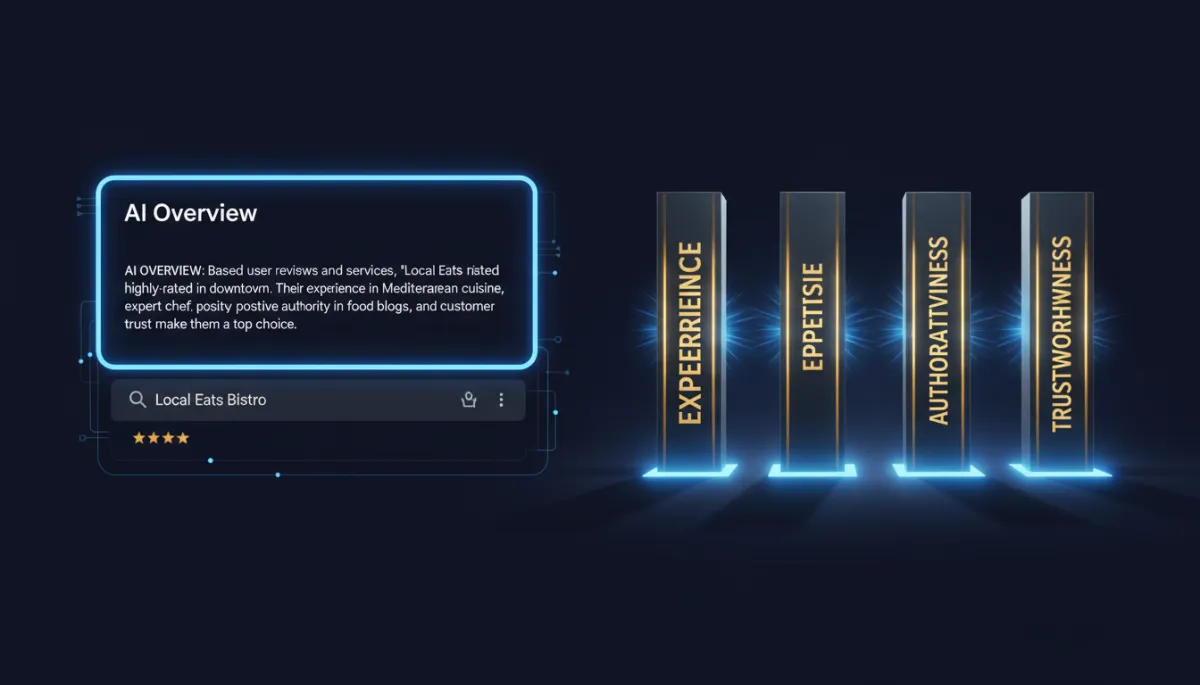
E-E-A-T stands for Experience, Expertise, Authoritativeness, and Trustworthiness - Google's framework for evaluating whether a business deserves to be surfaced to searchers. Google has used these quality signals in its evaluations for years, but in 2026, they have become the primary language that AI systems use to decide which local businesses to recommend.
Here is how each pillar translates for a local service business:
- Experience: Demonstrated real-world proof that you have done the work. Customer reviews describing specific outcomes, before-and-after photos, case studies, and testimonials are all Experience signals that AI systems actively scan and extract.
- Expertise: Content that shows deep knowledge of your service area. This includes detailed service descriptions, author bios with credentials, blog posts that answer the questions your customers actually ask, and local market-specific knowledge that a generic national brand could not replicate.
- Authoritativeness: Third-party validation of your business. This means citations in local directories, mentions in local news or industry publications, backlinks from credible sources, and consistent appearance across the digital ecosystem surrounding your business.
- Trustworthiness: The technical and factual integrity of your online presence. Consistent NAP (Name, Address, Phone) across all platforms, HTTPS, LocalBusiness Schema markup, accurate business hours, and a genuine review profile with owner responses all feed this signal.
When these four pillars are strong, Google's AI has what it needs to confidently recommend your business. When they are weak or inconsistent, AI filters you out, even if you are ranking in position one organically.
How AI Overviews Work and Why Local Businesses Disappear From Them
Google AI Overviews are AI-generated answer boxes that appear above the traditional map pack and organic links for an expanding range of local search queries. When an AI Overview appears, it compresses what used to be ten organic links and a map pack into a single synthesized paragraph with two or three cited sources. The businesses cited get visibility. The businesses not cited lose traffic, even if they rank in position one organically.
Here is what AI Overviews pull from when generating local business answers:
- Your Google Business Profile - categories, services, descriptions, photos, reviews, and posts
- Your website content - especially FAQ pages, service pages with specific descriptions, and LocalBusiness Schema markup
- Your review content - reviews that mention specific services, outcomes, and local details are treated as primary source-of-truth data
- Your citation footprint - how consistently your business appears across directories, social platforms, and third-party websites
The businesses that fail to appear in AI Overviews share common traits: keyword-stuffed websites with thin content, incomplete or inconsistent GBP profiles, and sparse review profiles that do not mention specific services. AI is looking for genuine expertise and trustworthiness, not just proximity and category matching.

The 5 Trust Signals AI Uses to Decide Who Gets Cited
Based on research from leading local SEO authorities in 2026, here are the specific signals that determine whether your business gets recommended by AI:
1. A Complete, Accurate Google Business Profile
Your GBP is the single most influential data source for local AI search. Research shows 56% of US businesses have not fully optimized their GBP, creating a massive opportunity gap for those who do. Every field matters in 2026: your primary category (the single biggest ranking lever), service list with individual descriptions, business description (750 characters, use them wisely), attributes, products, and posts. Each service listing is a separate fact that AI can quote back in an answer. Incomplete profiles get filtered out of AI results at the first stage of candidate selection.
2. Service-Specific Website Content That Answers Real Questions
Local business websites that get cited in AI Overviews share one characteristic: they answer the exact questions customers ask before making a purchase decision. Generic content like we provide marketing services in Sacramento, call us today is actively working against you in 2026.
The content that AI Overviews surface is structured, specific, and directly answers informational and commercial queries. Add a dedicated FAQ section to your homepage and each service page. Write in plain, conversational language and implement FAQ Schema markup so Google can parse your answers directly. In 2026, your blog is your primary tool for getting cited in AI-generated answers across Google, ChatGPT, and Perplexity simultaneously.
3. LocalBusiness Schema Markup
Schema markup is the structured data language that tells search engines and AI systems exactly what your business is, where it operates, what it offers, and who it serves. LocalBusiness Schema on your website reinforces the information in your GBP and cross-validates your business identity across the web. Include your business name, address, phone, hours, service area, and service descriptions in your schema. This is the official script that AI references when generating answers about your business, and one of the most underused technical advantages available to local businesses today.
4. A Strong, Specific, Recent Review Profile
Reviews are not optional in 2026. 87% of consumers will not consider a business rated below 4 stars, and Google's AI factors review volume, recency, and response rate directly into local visibility. But in the AI era, the content of reviews matters as much as the star rating.
AI systems treat customer reviews as primary source-of-truth data. A review that says great service provides minimal AI signal. A review that describes a specific service, a specific outcome, and the location gives Gemini attributable facts it can use when answering local queries. Guide your customers to leave detailed reviews mentioning specific services, outcomes, and your city or service area. Respond to every review personally, because AI uses owner responses to evaluate how actively engaged a business is with its customers.
5. Consistent NAP Across the Entire Digital Ecosystem
AI systems cross-check your business information across multiple sources simultaneously to confirm legitimacy. When your business name, address, and phone number are identical on Google, Yelp, Facebook, Foursquare, and industry-specific directories, that consistency is a strong trust signal. When they vary even slightly, old phone numbers, abbreviating Street to St in one place and not another, missing suite numbers, AI registers the inconsistency as a reliability flag. Audit your NAP across all platforms quarterly and fix every discrepancy immediately.
Answer Engine Optimization: The New Local SEO Discipline
The businesses winning AI citations consistently in 2026 have adopted a mindset shift: from Search Engine Optimization to Answer Engine Optimization (AEO), the discipline of structuring your entire online presence so AI systems can understand, trust, and recommend your business without hesitation.
AEO is not a replacement for traditional local SEO. It is an evolution of it. The same signals that make you visible in Google AI Overviews, clean structured data, consistent NAP, strong E-E-A-T, and fresh content, are the same signals that make you visible to ChatGPT, Perplexity, and Gemini when users ask those platforms for local business recommendations. A business with all these signals strong performs better across every AI surface simultaneously.
The key mindset shift is this: the question is no longer where does my business rank in the local pack. The question is: Is my business clear, consistent, and credible enough that AI can confidently recommend me to someone looking for my service? If the answer is no, your business drops out of every AI results channel at once.

The Zero-Click Reality: How to Win Even When Nobody Clicks
Here is the strategic reality of 2026 local search: 60% of searches now end without a click, because AI answers the question directly on the results page. For local businesses, this means even if a customer never visits your website, they may still call you, request directions, or book an appointment based entirely on what AI tells them.
This is actually an opportunity, not just a threat. When your business is cited in an AI Overview, the people who do click or call are high-intent leads who have already received an AI-generated endorsement. When your business is the answer, the people who find you are usually ready to book.
To win the zero-click game, your information must be findable and accurate everywhere Google's AI looks: your GBP, your website, your reviews, and your citation network. The businesses most resilient in 2026 are the ones with presence across multiple search features simultaneously: organic results, local pack, GBP card, AI Overviews, and voice results.
Your 2026 E-E-A-T and AI Visibility Action Plan
Here is where to start this week:
- Audit your GBP completeness - Fill in every single field: business description, services with individual descriptions, hours, service area, website link, and accepted payment methods. Each service is a data point AI can surface in answers.
- Add FAQ content to your website - Create a dedicated FAQ section on your homepage and each service page. Answer the actual questions your customers ask before hiring you, in plain conversational language. Implement FAQ Schema markup.
- Add LocalBusiness Schema to your website - Include your full business details, service area, services offered, and hours. This cross-validates your business identity and gives AI its official script about your business.
- Build a systematic review request process - Contact every customer within 24 hours of service completion. Brief them on being specific: mention the service, the outcome, and the location. Respond to every review personally within 48 hours.
- Audit your NAP consistency - Search your business name across Google, Yelp, Facebook, Apple Maps, Bing Places, and any industry directories. Fix every inconsistency, even small formatting differences.
- Publish content that answers pre-purchase questions - Identify the 10 most common questions your prospects ask before hiring you. Write a dedicated blog post or FAQ entry for each one. These are your AI citation opportunities.
The Bottom Line: The Local Businesses AI Trusts Are the Ones That Win
The local businesses dominating search in 2026 are not winning because of tricks or algorithm hacks. They are winning because they have built the kind of clear, consistent, well-documented digital presence that Google's AI can trust enough to surface with confidence, across AI Overviews, the local 3-Pack, Ask Maps, and increasingly across ChatGPT and Perplexity as well.
E-E-A-T is not a checklist you complete once. It is an ongoing commitment to showing up as a genuinely credible business across every platform where your customers are looking. The businesses that treat their digital presence as a trust-building system, not just a ranking game, are the ones that will still be winning local search two, three, and five years from now.
At Future Level Marketing, we help local businesses across Sacramento and the Central Coast build exactly this kind of AI-ready presence, from GBP optimization and schema implementation to content strategy and review management. Book your free local marketing audit today and find out where your business stands in the 2026 AI search landscape.
Shawn Kelly is the founder of Future Level Marketing LLC, a Sacramento-based digital marketing agency specializing in AI-powered local marketing, Google and Facebook Ads, Local SEO, and Google Business Profile optimization for small businesses across California and the Central Coast.